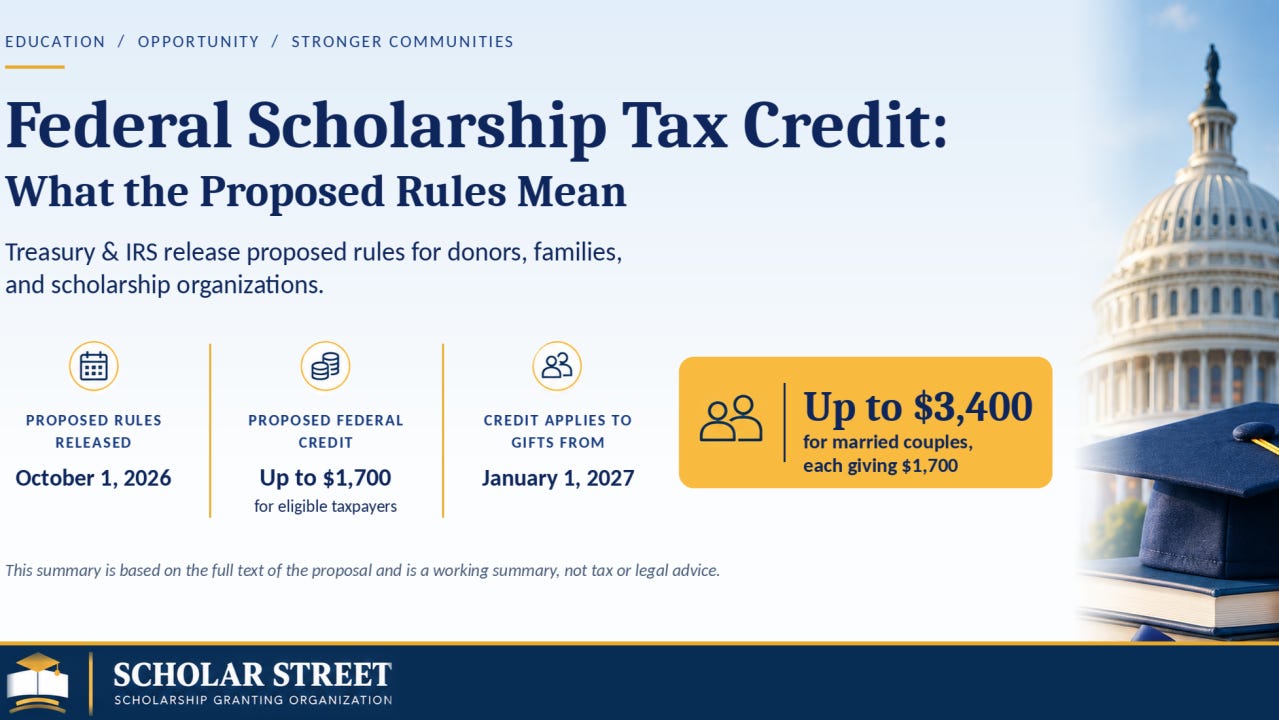
Treasury and the IRS released proposed rules for the federal scholarship tax credit this week, and there is a lot of good news in them for donors, families, and scholarship organizations. Several answers came back better than many of us expected, starting with a credit of up to $3,400 for married couples. This piece summarizes what the proposal says, what it changes from common assumptions, and what remains to be confirmed. It is based on the full text of the proposal and is a working summary, not tax or legal advice.
What was released
The proposed regulations (REG-117199-25, “Federal Scholarship Tax Credit”) implement IRC §25F, the federal credit for donations to scholarship granting organizations (SGOs). They were released October 1, 2026 and publish in the Federal Register on October 2. They are proposed, not final.
Comments: due roughly 60 days after publication, about December 1, 2026.
Hearing: Tuesday, December 15, 2026 at 10 a.m. ET, and cancelled if no one requests to speak.
Effective timing: the credit applies to gifts made starting January 1, 2027, and only in states whose governors opt in. Taxpayers, organizations, and states may rely on the proposed rules for gifts made on or after that date if they follow the applicable provisions in their entirety and consistently.
Families: scholarships an SGO pays after December 31, 2026 are not taxable income to the family under new §139K.
Requests to attend the hearing are due by 5 p.m. ET on Thursday, December 10, 2026.
For donors
The credit is per taxpayer: up to $1,700 per individual per year, dollar for dollar against federal tax owed.
Married couples: this is the headline. Spouses are treated as two taxpayers, which is better than the $1,700 per return many of us had assumed. If each spouse makes their own gift of up to $1,700, a couple filing jointly can claim up to $3,400. Each spouse’s gift has to be recorded as theirs.
Credit, not deduction: the credit is nonrefundable, so it cannot exceed the tax you owe. Unused credit carries forward up to five years. The credited portion of a gift cannot also be deducted as a charitable contribution. In Treasury’s own example, a couple who each give $2,000 receive $3,400 in credits, and the remaining $600 may be deductible if it meets the charitable deduction rules.
Individuals only: gifts made through a partnership or S corporation do not qualify, even where the owner may deduct them. The donor gives directly.
Cash only: currency, check, money order, card, ACH, or after-tax payroll deduction. Crypto and other digital assets do not count.
Any participating state: donors can give to an SGO on any participating state’s list, wherever the donor lives. The money funds students who live in that SGO’s state.
No Social Security number to the SGO: each SGO issues a donor number instead. Donors report it on IRS Form 8525 when claiming the credit.
Designate at the time of the gift: a gift must be designated as a §25F contribution when it is made, and the designation cannot be reversed afterward.
Stacking with state credits
The proposal lets donors keep a state scholarship credit without shrinking the federal one, as long as the gift is large enough to cover both. The state credit is subtracted from the gift first, and then the $1,700 cap applies. That ordering is what keeps a state credit from reducing the federal credit when the gift is large enough.
Per individual, the federal credit is the lesser of the gift minus the state credit, or $1,700.
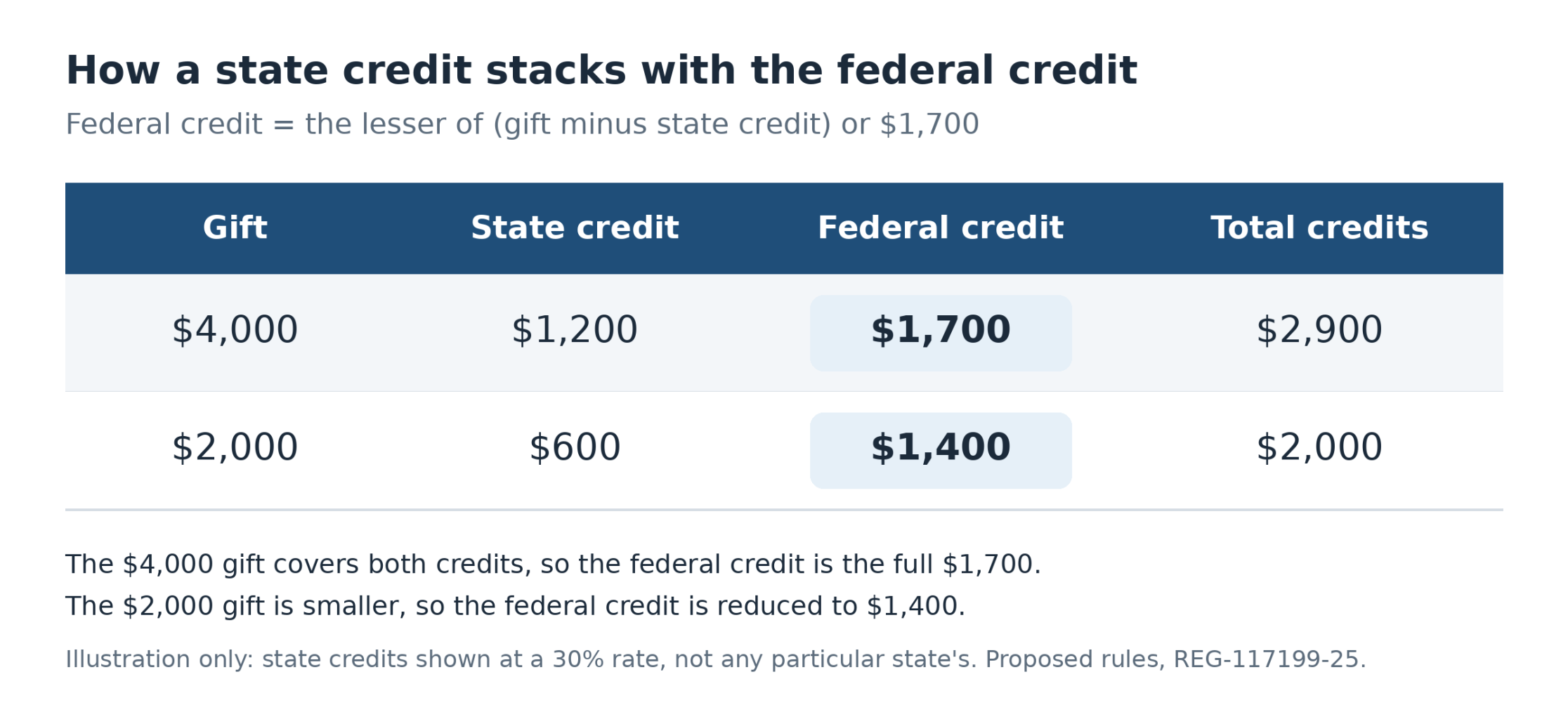
In the first row the gift covers both credits, so the federal credit is the full $1,700. In the second row the gift is smaller, so the federal credit is reduced. The state credit amounts here are an illustration at a 30% rate, not any particular state’s.
If a donor gives some money as a §25F designated gift and some outside it, the state credit is treated as coming from the non-designated money first, which protects the federal credit. In Treasury’s own example, a donor gives $4,000, designates $1,700 as a qualified contribution, and claims a $400 state credit. The credit is applied to the $2,300 non-designated portion first, so the full $1,700 federal credit stands.
For scholarship granting organizations
The proposal turns the statute’s SGO requirements into specific operating rules. The most consequential are the 90% spending rule, the 85% activity safe harbor, and the new registration and reporting steps.
What qualifies as an SGO
A 501(c)(3) public charity, not a private foundation, listed by a participating state.
§25F gifts go into a separate account holding only qualified contributions and their earnings, with a complete set of books. A gift designated as §25F goes into that account even if the donor never claims the credit.
“Located in the State” means authorized to do business there and in compliance with that state’s charity laws. No physical office or in-state staff is required.
States cannot add requirements stricter than the federal definition. An SGO may choose to be stricter on its own.
A multistate SGO keeps a separate account per state and lets donors choose the state their gift supports.
The 90% rule and the 85% safe harbor
By default, an SGO must spend 90% of its total gross receipts from all sources on scholarships. If at least 85% of the organization’s activity is scholarship-related, the 90% applies only to §25F contributions and their earnings, and separately raised money stays available to run the organization. Scholarship-related activity includes administration, fundraising, governance, compliance, and outreach done in support of scholarships. Programs such as running its own tutoring or advocacy count against the 85%. Under the proposal, the safe harbor is optional for a single-state SGO and required for a multistate SGO, and how the 85% is measured is not defined. Treasury is asking for comments on that.
Two-year window: each year’s income must be 90% spent by the end of the following tax year.
Cash basis: money counts as spent when paid, not when awarded. Payments apply to the earliest year’s income first. Refunds count as new income when returned.
Digital wallets: funds moved to a qualified third-party wallet count as spent on the transfer date, if the SGO no longer owns them.
Registration, donor numbers, and reporting
Register on the new IRS SGO portal as soon as possible, preferably before appearing on a state list. The portal provides the donor-number format.
Issue a donor acknowledgement by January 31 following the gift year, with the SGO’s EIN, the donor’s total designated gifts, and the donor number.
Report to the IRS by February 28, per donor number: name, address, and annual total.
File an annual certification with the Form 990, copied to each listing state, and obtain an annual audit. With receipts of $500,000 or less, a committee of independent people may perform it. Above that, it must be an independent professional or accredited body.
Paying out scholarships
Allowed expenses follow the Coverdell rules, with more detailed guidance promised separately.
Tuition, fees, and room and board are paid directly to the school. Other vendors may be paid directly if verified. Families can be reimbursed against receipts the SGO verifies.
Fraud controls are required, including detection of duplicate awards for the same expense.
At least 10 students must receive awards, not all at the same school. Contributions cannot be earmarked for a particular student.
For students and families
Eligibility is based on household income of up to 300% of area median income, measured for the calendar year before the application. An SGO may set a lower limit. The IRS plans to publish the limits annually by area and family size.
Household: the student plus everyone living with them, following HUD Section 8 rules, not the tax filing unit. Only income received in cash counts, and child support and alimony count.
Four ways to verify income: direct documents such as pay stubs, returns, and W-2s; a categorical award letter dated within 12 months showing SNAP, TANF, WIC, Section 8, or SSI; a safe harbor for individual tutoring and special-needs services at schools in qualified low-income census tracts, with an annual third-party audit; and automatic eligibility for foster children. School-wide free lunch eligibility does not count.
Residence, not school location: the state that counts is where the student lives. A student can use a scholarship from an SGO in their home state at a school across the state line. There are exceptions for military dependents and students living on Indian Lands.
Eligibility to enroll: the student must be eligible to enroll in a public K-12 school. They do not have to be enrolled when they apply.
Award priority: students who received an award the prior year come first, then siblings of recipients. The proposal allows more flexibility for tutoring and special-needs awards.
What it can pay for: expenses allowed under the Coverdell rules. Detailed guidance on qualified expenses is expected separately as a priority.
Who cannot receive a scholarship
Officers, directors, trustees, and anyone with similar powers.
Anyone who helps select recipients, including unpaid selection committee members, with no exception for blind or anonymous selection.
Substantial contributors: donors who gave more than $5,000 and more than 2% of the §25F account’s contributions in a tax year, with spouses combined. The status lasts that year and the next.
Family members of all of the above, including spouses, parents, grandparents, children, grandchildren, siblings, nieces and nephews, and their spouses.
An award is not a violation if the recipient was not disqualified on the award date and the SGO had no reason to expect it.
For states
The credit is available only in states whose governors opt in, and the opt-in is renewed one year at a time. Treasury’s proposal notes that 30 states had elected to participate as of August 2026.
2027 deadlines: an advance election on Form 15714 by January 1, 2027, and the state’s SGO list by February 15, 2027. A state opting in for the first time must use the advance election.
2028 and later: advance elections run January 2 through September 30 of the prior year through a new IRS state portal. An election and list can also be filed together from October 1 through January 1.
Who can elect: the governor or a designee under state law. A non-governor must show the statute or regulation that gives them that authority.
No added requirements: states cannot add requirements stricter than the federal definition of an SGO, and a state that lists organizations with pending tax-exempt applications must list all such organizations that seek inclusion.
Revocation: once an election is completed it cannot be revoked for that year.
The IRS will publish a list of states that have filed advance elections.
What remains to be confirmed
These are proposed rules. The points below are open for comment or need professional confirmation before anyone relies on a specific outcome. Donors should check their own situation with a CPA.
Joint returns and state credits: how a state credit is attributed between spouses on a joint state return, which feeds the federal calculation.
Joint payments: each spouse is a separate donor with their own donor number and acknowledgement. The proposal does not say whether one payment from a joint account can be split between spouses.
After-tax results: the real after-tax value of combining credits for a given donor, including any effect on deductions. This needs a CPA.
Stacked gifts and eligibility: stacked gifts must satisfy the rules of both programs, including any state income limits for students.
The 85% test: how scholarship-related activity is measured (money, staff time, receipts) is undefined, and startup-year relief is a likely comment topic.
Qualified expenses and digital wallets: detailed guidance on qualified expenses is expected separately, and the definition of a qualified wallet will matter for how awards are paid.
Categorical eligibility and state coordination: the list of qualifying benefit programs may expand through comments, and how state credits interact where a state’s student income test differs is open.
Final rules: the rules may change before they are final. Reliance on the proposal applies only if taxpayers, organizations, and states follow its applicable provisions in their entirety and consistently.